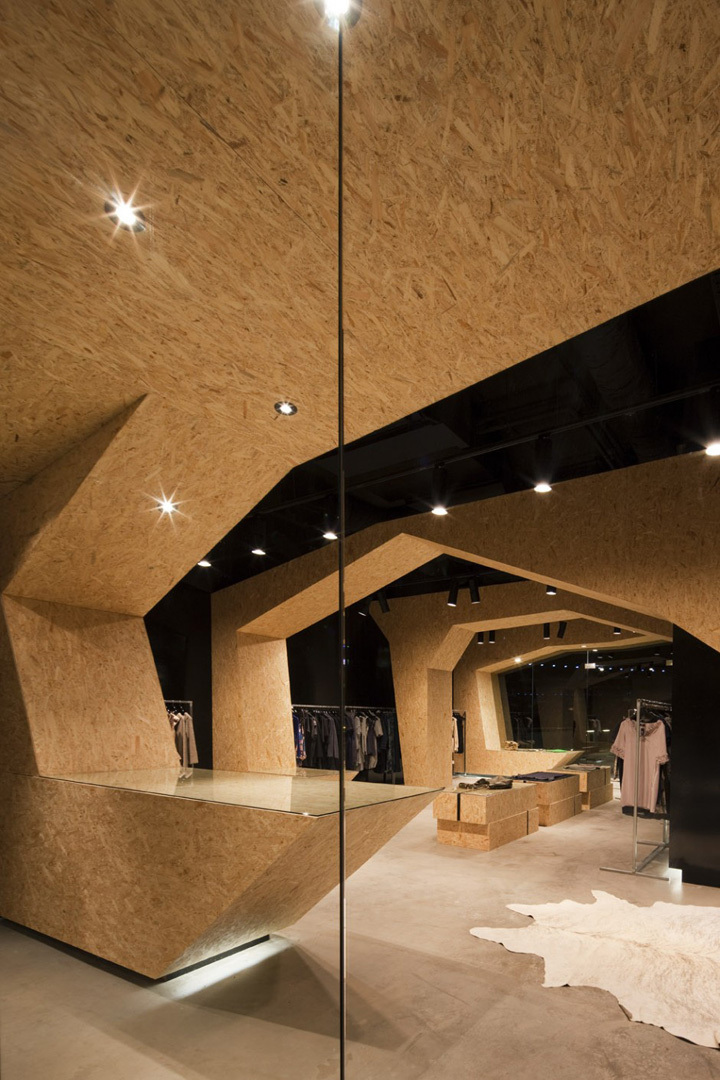
Fame Agenda Store, Matt Gibson
Conventionally OSB (orientated strand board) has been constrained to the dark abyss of our domestic lofts as a cheap flooring finish. However its use within commercial environments is on the increase and in my opinion quite rightly so.
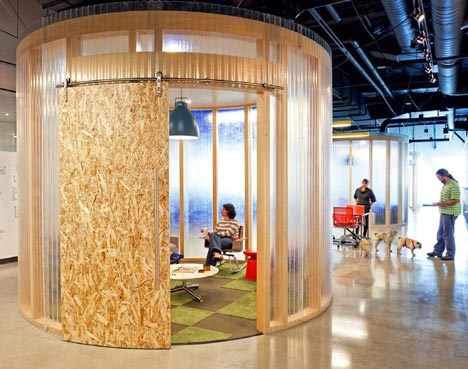
AOL Offices by O+A
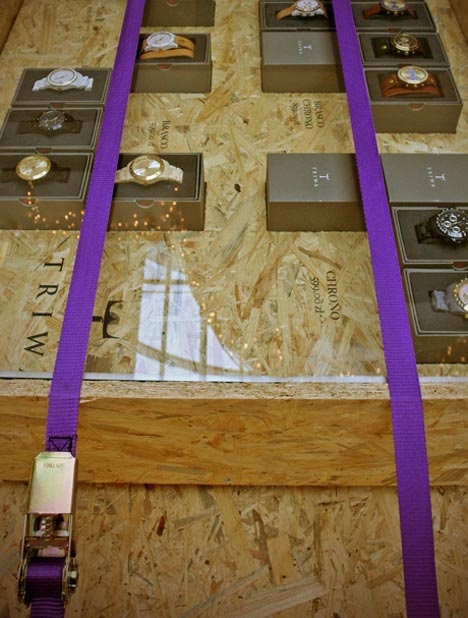
As the above projects show, it can be used for a variety of Interior components and it is slowly becoming the replacement for plywood panels. Why? Well OSB is cheap, rigid and adds a variation in tone, pattern and texture. These very properties means that it easily available and can be cnc cut to create more challenging planar faces as seen in the fame agenda store example above.
Tube Tank TRIWA pop up shop by Mode:lina Architects
The manufacturing process sees 'flakes' of wood engineered in an array of orientations (hence orientated strand board) and compressed into mats of conventional sized boards (6, 12 and 18mm) bonded together with a mixture of resin and wax. Plywood does have some advantages over OSB, predominantly that OSB is difficult to treat. Because of the resin mixed into the strands the board is not completely porous, unlike Plywood, and therefore does not absorb the treatment making it extremely unsuitable for exterior use.
The video below outlines the manufacturing process of the UK's largest OSB supplier, SterlingOSB, who have the capability of producing over a million square feet of this versatile product each day.